
Updated November 2026. Refreshed monthly.
Most mortgages in America are conventional. Lenders made 3,201,000 conventional first mortgages in 2025, more than twice the number of FHA, VA and USDA loans put together (FHFA National Mortgage Database, Sep 2026).
Most people who hold one locked in their rate years ago, and they guard it. That rate is only half of the picture. The cards and loans beside the mortgage often cost far more, and nobody was taught to count them as part of the real cost of borrowing.
Every number below links to the group that produced it: Fannie Mae, Freddie Mac, the Federal Housing Finance Agency, the lenders' own federal mortgage reports, the mortgage insurers' filings, the Federal Reserve and the Mortgage Bankers Association. No roundups, no copies of copies.
Key Takeaways
- Conventional loans were 68.4% of the first mortgages made in 2025 (FHFA National Mortgage Database, Sep 2026).
- 53.8% of conventional refinances in 2025 took cash out (FHFA National Mortgage Database, Sep 2026).
- 55% of the loans in Fannie Mae's single-family book carry an interest rate under 4% (Fannie Mae 10-Q, Oct 2026).
- The average 30-year fixed mortgage rate is 7.28%, up from 6.26% a year ago (Freddie Mac PMMS, Nov 2026).
- The average credit card rate is 21.19% (Federal Reserve, Sep 2026).
- Freddie Mac's new home loans in the third quarter of 2026 had an average credit score of 759 (Freddie Mac, Oct 2026).
- 2% of the loans Fannie Mae bought in the third quarter of 2026 went to borrowers with credit scores under 620, up from under 0.5% a year earlier (Fannie Mae 10-Q, Oct 2026).
- 27% of the loans Fannie Mae bought in the third quarter of 2026 were for more than 90% of the home's value (Fannie Mae 10-Q, Oct 2026).
- Conventional loans had a 2.72% delinquency rate in mid-2026, against 11.79% for FHA loans and 4.89% for VA loans (MBA, Aug 2026).
- Fannie Mae and Freddie Mac loans that started with a credit score under 660 were 7.60% delinquent in August 2026, against 1.56% for loans that started at 660 or higher (FHFA Refinance Report, Aug 2026).
- A drop in income was the top reason Fannie Mae and Freddie Mac borrowers fell behind, named in 28% of cases (FHFA Refinance Report, Aug 2026).
- United Wholesale Mortgage made 247,358 first-lien conventional loans in 2025, and Rocket Mortgage made 226,953 (HMDA, Nov 2026).
- The 2026 conforming loan limit is $832,750 for a one-unit home (FHFA, Nov 2025).
How Big Is the Conventional Mortgage Market?
Conventional is the default mortgage in America, and the government programs are the exception. Even in a slow year, conventional lending outnumbers FHA, VA and USDA lending by more than two to one.
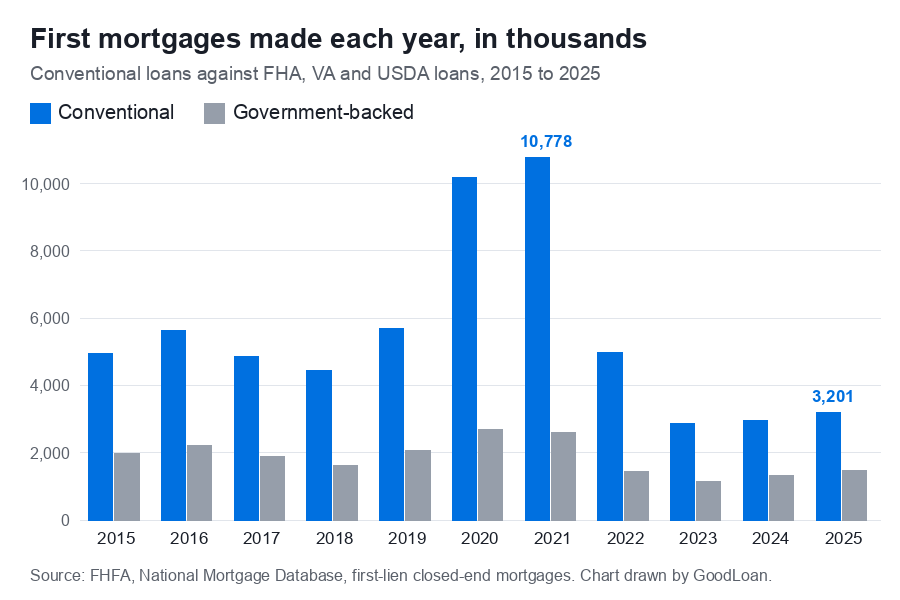
Figure 1: Conventional lending nearly doubled in the 2020 and 2021 refinance boom and then fell below its 2015 level, while government-backed lending moved far less, which shows how much of the conventional market rides on rates. Source: Federal Housing Finance Agency, National Mortgage Database Aggregate Statistics, Sep 2026. Chart drawn by GoodLoan from the source's data, 20 Nov 2026.
What share of new mortgages are conventional?
About two in three first mortgages, and closer to four in five when home equity lines are counted.
- Conventional first mortgages made in 2025 added up to $1.24 trillion (FHFA National Mortgage Database, Sep 2026).
- Fannie Mae and Freddie Mac bought 65.4% of the conventional first mortgages made in 2025 (FHFA National Mortgage Database, Sep 2026).
- Counting every lien, including home equity lines and second mortgages, lenders reported 5,320,033 conventional loans made in 2025, against 906,942 FHA loans and 561,783 VA loans (HMDA, Nov 2026).
- That all-lien conventional count was up 10.0% from 4,838,149 in 2024 (HMDA, Nov 2026).
How many conventional mortgages are open right now?
Close to 40 million, most of them backed by Fannie Mae or Freddie Mac.
- About 39,287,000 conventional first mortgages were active in mid-2026, out of 51,426,000 first mortgages in all (FHFA National Mortgage Database, Sep 2026).
- Fannie Mae and Freddie Mac backed 29,285,000 of those conventional loans (FHFA National Mortgage Database, Sep 2026).
- Fannie Mae's single-family conventional book held 16,769,000 loans at the end of September 2026 (Fannie Mae 10-Q, Oct 2026).
- Freddie Mac's single-family mortgage portfolio was $3.2 trillion, up 1% from a year earlier (Freddie Mac, Oct 2026).
How much are lenders making right now?
Hundreds of billions of dollars a quarter, with conventional loans the largest slice.
- Lenders made $595 billion in new mortgage debt in the third quarter of 2026, across all loan types (New York Fed, Nov 2026).
- Fannie Mae bought $88.3 billion of single-family conventional loans in the third quarter of 2026, down from $111.2 billion in the second quarter (Fannie Mae, Oct 2026).
- Freddie Mac's new single-family business was $98 billion in the quarter, down from $99 billion a year earlier (Freddie Mac, Oct 2026).
- Freddie Mac financed 286,000 single-family homes in the quarter, against 306,000 in the second quarter (Freddie Mac, Oct 2026).
Who Gets a Conventional Loan?
The averages describe the loans Fannie Mae and Freddie Mac buy, and those books are built from the top of the credit range. Every borrower is more than an average. Each program has its own score rules.
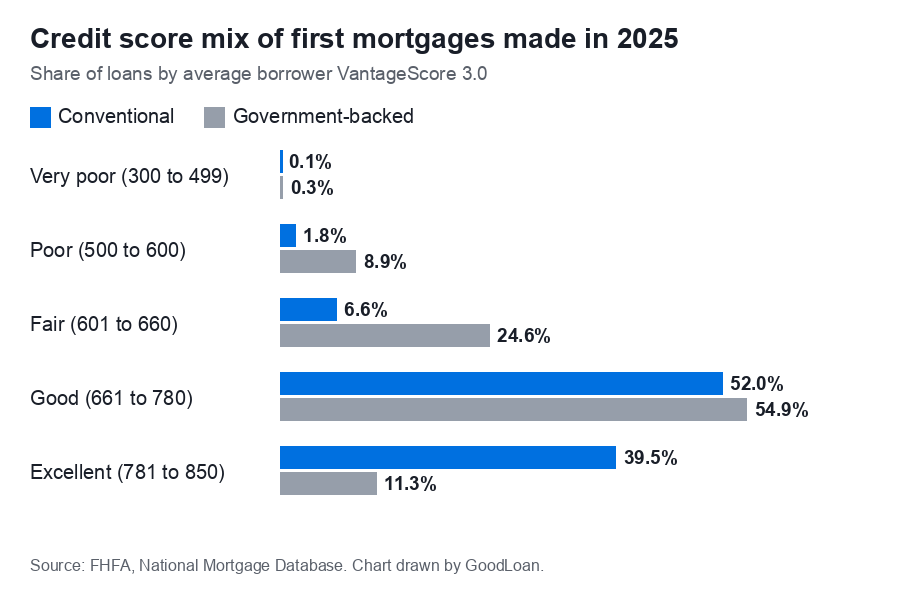
Figure 2: Fewer than one conventional first mortgage in ten went to a borrower with a score of 660 or below in 2025, against about one in three government-backed loans, so the two markets serve two different credit profiles. Source: Federal Housing Finance Agency, National Mortgage Database Aggregate Statistics, Sep 2026. Chart drawn by GoodLoan from the source's data, 20 Nov 2026.
What credit scores do conventional borrowers have?
Mostly in the 700s, and higher than borrowers on government-backed loans.
- The loans Fannie Mae bought in the third quarter of 2026 had a weighted average FICO score of 755, and 66% of them went to borrowers at 740 or higher (Fannie Mae 10-Q, Oct 2026).
- Conventional first mortgages made in 2025 had an average VantageScore of 753.6, against 692.8 for government-backed loans (FHFA National Mortgage Database, Sep 2026).
- 8.5% of conventional first mortgages made in 2025 went to borrowers with an average VantageScore of 660 or below (FHFA National Mortgage Database, Sep 2026).
- 1,567,000 of the 30,464,000 loans Fannie Mae and Freddie Mac serviced in August 2026 started with a credit score under 660, or 5.1% (FHFA Refinance Report, Aug 2026).
How have the credit score rules changed?
Fannie Mae dropped its fixed 620 floor for loans run through its own underwriting system, and both companies now take a second scoring model.
- Fannie Mae removed its 620 minimum credit score for loans run through its Desktop Underwriter system in November 2025 and replaced it with a minimum credit risk standard (Fannie Mae 10-Q, Oct 2026).
- Loans scored with VantageScore 4.0 were 6% of Fannie Mae's acquisitions in the third quarter of 2026 (Fannie Mae 10-Q, Oct 2026).
- 6% of Freddie Mac's new loans in the quarter were priced using VantageScore 4.0, after it opened that score to all lenders (Freddie Mac, Oct 2026).
- Since October 1, 2026, Fannie Mae has applied the same pricing adjustments to loans scored with VantageScore 4.0 or classic FICO (Fannie Mae 10-Q, Oct 2026).
How much debt do conventional borrowers carry?
More than the old rules of thumb suggest. About a quarter of new loans go to borrowers spending more than 45% of income on debt.
- Debt payments took 38% of income on the average loan Fannie Mae bought in the third quarter of 2026, and 27% of its loans went above 45% (Fannie Mae 10-Q, Oct 2026).
- 26% of the loans Freddie Mac bought in the quarter had a debt-to-income ratio above 45%, down from 28% a year earlier (Freddie Mac 10-Q, Oct 2026).
- 30.3% of conventional first mortgages made in 2025 had a debt-to-income ratio of 44% or more, against 54.9% of government-backed loans (FHFA National Mortgage Database, Sep 2026).
How many conventional buyers are buying their first home?
About half of them.
- First-time buyers took 51% of Freddie Mac's home purchase loans in the third quarter of 2026, or 106,000 buyers (Freddie Mac, Oct 2026).
- Fannie Mae financed nearly 103,000 first-time buyers in the quarter, 53% of its single-family purchase acquisitions (Fannie Mae, Oct 2026).
- 47.8% of conventional home purchase loans made in 2025 had at least one first-time buyer on them (FHFA National Mortgage Database, Sep 2026).
How Much Do Conventional Borrowers Put Down, and Who Pays for Mortgage Insurance?
Plenty of conventional loans start with far less than 20% down. Private mortgage insurance is what makes that possible.
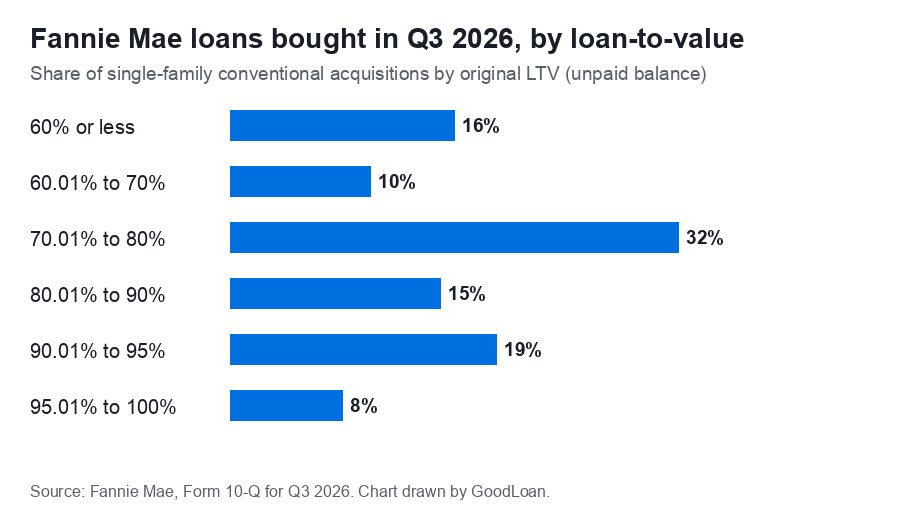
Figure 3: Less than three in ten of the loans Fannie Mae bought had 30% or more equity at the start, and more than four in ten were above 80% of the home's value, the point where mortgage insurance usually applies. Source: Fannie Mae, Form 10-Q for the quarter ended September 30, 2026, Oct 2026. Chart drawn by GoodLoan from the source's data, 20 Nov 2026.
How much do conventional borrowers put down?
Well under 20% on many loans. The averages sit near a quarter of the home's value.
- The loans Fannie Mae bought in the third quarter of 2026 averaged 78% of the home's value at the start (Fannie Mae 10-Q, Oct 2026).
- Freddie Mac's new loans averaged 77% of the home's value (Freddie Mac, Oct 2026).
- 24% of the loans Freddie Mac bought in the quarter were for more than 90% of the home's value (Freddie Mac 10-Q, Oct 2026).
- Conventional home purchase loans made in 2025 averaged 75.1% of the price (FHFA National Mortgage Database, Sep 2026).
When is private mortgage insurance required?
On most conventional loans above 80% of the home's value.
- Fannie Mae's charter generally requires credit protection on any single-family loan it buys with a loan-to-value ratio over 80%, which it usually gets through primary mortgage insurance (Fannie Mae 10-Q, Oct 2026).
- 21% of Fannie Mae's single-family book had primary mortgage insurance or similar protection (Fannie Mae 10-Q, Oct 2026).
- 22% of Freddie Mac's single-family portfolio had primary mortgage insurance (Freddie Mac 10-Q, Oct 2026).
How big is the private mortgage insurance business?
Each of the large insurers backs a quarter of a trillion dollars or more of home loans.
- MGIC wrote $17.1 billion of new insurance in the third quarter of 2026 and had $307.3 billion in force (MGIC, Nov 2026).
- Essent wrote $12.1 billion of new insurance and had $250.1 billion in force (Essent, Nov 2026).
- Enact wrote $14 billion of new insurance and had $275 billion in force (Enact, Nov 2026).
- 94.3% of Essent's new insurance in the quarter covered home purchases, and the insured loans averaged 93% of the home's value (Essent, Nov 2026).
- 5.4% of Essent's new insurance went to borrowers with credit scores of 679 or below (Essent, Nov 2026).
- Essent's premiums earned came to 0.40% a year of the insurance it had in force, a business figure for the insurer that no borrower is quoted as a price (Essent, Nov 2026).
When does PMI come off?
When the balance reaches set points of the home's original value.
- You can ask your servicer to cancel PMI once your balance is scheduled to fall to 80% of the home's original value (CFPB, Aug 2026).
- Your servicer must end PMI automatically when the balance is scheduled to reach 78% (CFPB, Aug 2026).
- Your servicer must also end PMI the month after the loan reaches the midpoint of its payment schedule (CFPB, Aug 2026).
- 82.5% of MGIC's insurance was still in force after a year, which the insurer calls persistency (MGIC, Nov 2026).
If you already have a conventional loan and want to see it next to everything else you owe, we build that plan at conventional.goodloan.ai, with no impact on your credit score to see your numbers. Call, text or chat (866) 599-0088, 8am to 8pm Eastern.
What Does a Conventional Loan Cost?
People judge a mortgage by its rate. The rate on a new loan is far above what most existing borrowers pay, and that gap is why so many stay put while the rest of their debt grows.
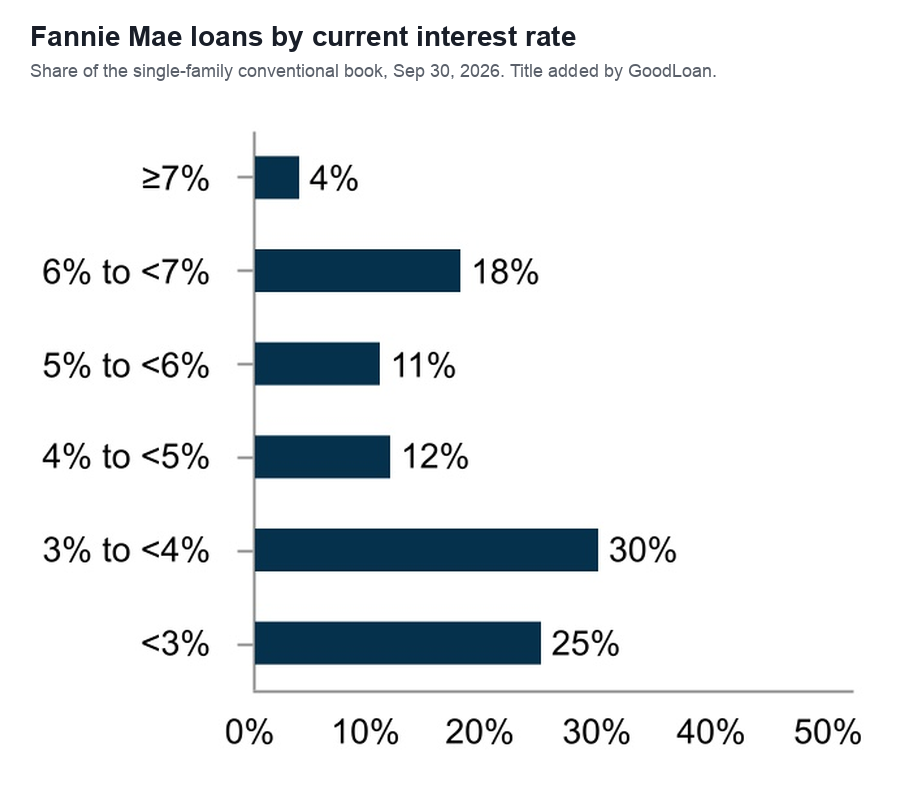
Figure 4: Most of Fannie Mae's loans carry rates far under today's market average, which is why a new loan's rate looks high to the people who hold them. Source: Fannie Mae, Form 10-Q for the quarter ended September 30, 2026, Oct 2026. Chart published by the source, title added by GoodLoan, captured 20 Nov 2026.
What rate do conventional borrowers pay?
New loans cost about 7%. Most existing loans cost far less.
- The average 15-year fixed mortgage rate was 6.66%, up from 5.54% a year earlier (Freddie Mac PMMS, Nov 2026).
- Conventional first mortgages made in 2025 carried an average rate of 6.4% (FHFA National Mortgage Database, Sep 2026).
- Substantially all of Fannie Mae's single-family book had a rate below the late-September market average, and Fannie Mae said that even at 5% most of its borrowers would have no rate reason to refinance (Fannie Mae 10-Q, Oct 2026).
- Active Fannie Mae and Freddie Mac loans carried an average rate of 4.2% in mid-2026, and 19.4% of them were at 6% or more (FHFA National Mortgage Database, Sep 2026).
- About 89% of the loans Enact insures carry rates below 7% (Enact, Nov 2026).
What fees do Fannie Mae and Freddie Mac charge?
About half a percentage point a year, built into the rate.
- Fannie Mae charged an average guaranty fee of 53.8 basis points on new conventional loans in the third quarter of 2026, down from 56.3 a year earlier (Fannie Mae, Oct 2026).
- Freddie Mac's average fee on new single-family loans was 53 basis points (Freddie Mac, Oct 2026).
- Freddie Mac adopted one pricing grid for FICO and VantageScore 4.0 loans in October 2026 (Freddie Mac 10-Q, Oct 2026).
What is the typical monthly payment?
About $3,000 a month on a new conventional loan, before the cards and other loans beside it.
- The first required payment on conventional first mortgages made in 2025 averaged $2,970, against $2,568 on government-backed loans (FHFA National Mortgage Database, Sep 2026).
- On card accounts that were charged interest, the average rate was 22.36% (Federal Reserve, Sep 2026).
- Credit card balances reached $1.29 trillion in the third quarter of 2026 (New York Fed, Nov 2026).
How Common Is Conventional Cash-Out Refinancing?
Rate drops drive most refinancing, so when rates rise, the refinances that remain are mostly about cash. People borrow against the house to clear debt that costs more than the mortgage does.
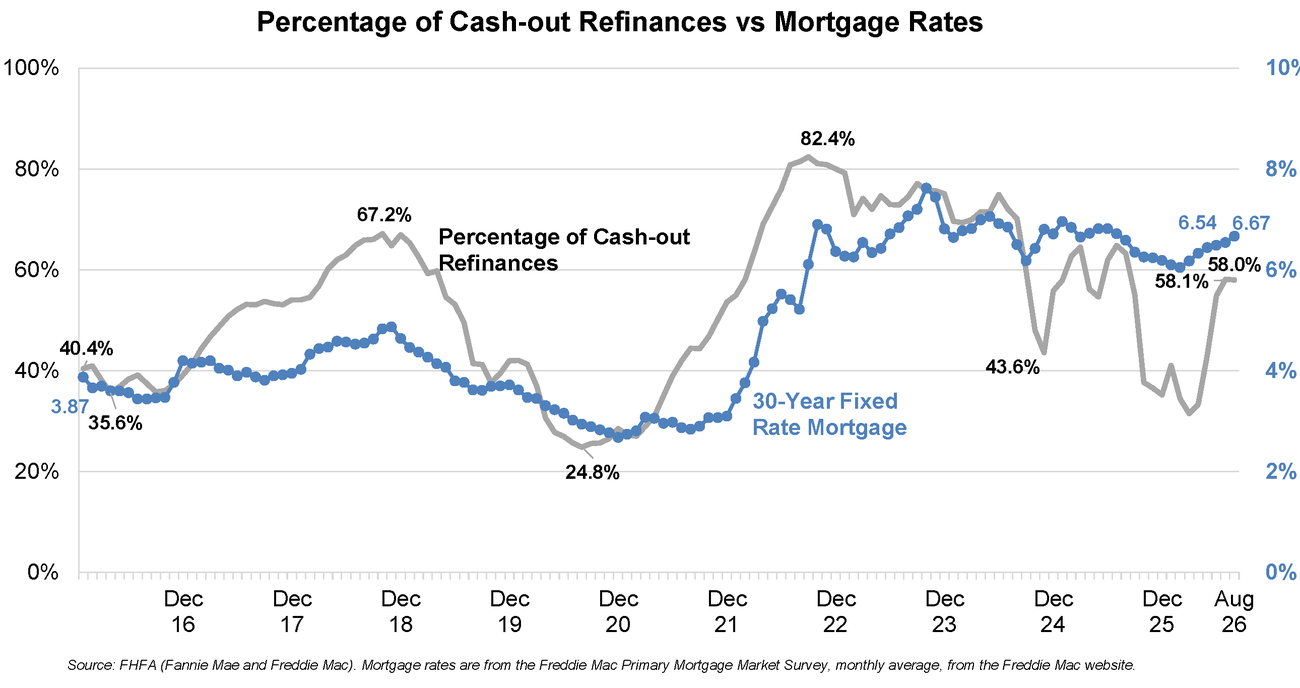
Figure 5: Cash-out share climbs whenever rates climb, because the rate-drop refinances fall away and the cash-out loans keep coming. Source: Federal Housing Finance Agency, Foreclosure Prevention and Refinance Report, August 2026, Aug 2026. Screenshot of the source page, captured 20 Nov 2026.
How many conventional refinances take cash out?
More than half of them in most recent months.
- 58.0% of Fannie Mae and Freddie Mac refinances in August 2026 were cash-out refinances, below the record 82.4% in September 2022 (FHFA Refinance Report, Aug 2026).
- The cash-out share was 54.4% in June 2026 (FHFA Refinance Report, 2Q 2026, Sep 2026).
- Cash-out refinances were 11% of the loans Fannie Mae bought in the third quarter of 2026, up from 10% a year earlier (Fannie Mae 10-Q, Oct 2026).
- Cash-out refinances were 9% of Freddie Mac's new business in the quarter (Freddie Mac 10-Q, Oct 2026).
How many conventional borrowers refinanced in 2026?
Fewer as the year went on and rates rose.
- Freddie Mac funded 64,000 refinances in the third quarter of 2026, down from 106,000 in the second quarter (Freddie Mac, Oct 2026).
- Fannie Mae and Freddie Mac refinanced 41,629 loans in August 2026, down from 46,974 in July (FHFA Refinance Report, Aug 2026).
- The two companies refinanced 223,082 loans in the second quarter of 2026, against 237,039 in the first (FHFA Refinance Report, 2Q 2026, Sep 2026).
- Lenders made 1,016,000 conventional refinances in 2025, up 31.9% from 770,000 in 2024 (FHFA National Mortgage Database, Sep 2026).
- Home purchases were 79% of the loans Fannie Mae bought in the third quarter of 2026 (Fannie Mae 10-Q, Oct 2026).
- 14.3% of Fannie Mae and Freddie Mac refinances in August 2026 went into 15-year loans (FHFA Refinance Report, Aug 2026).
Who takes a conventional refinance?
Borrowers around 50 years old, with credit scores in the 740s.
- Conventional refinance borrowers in 2025 were 50 years old on average, with an average VantageScore of 743.3 (FHFA National Mortgage Database, Sep 2026).
- The average conventional refinance in 2025 was $381,000 (FHFA National Mortgage Database, Sep 2026).
- The average active Fannie Mae or Freddie Mac loan was 41.3% of the home's current value in mid-2026 (FHFA National Mortgage Database, Sep 2026).
Your mortgage rate might be fine, and it is still only half of your finances. We build a plan around all of it at conventional.goodloan.ai. Call, text or chat (866) 599-0088, 8am to 8pm Eastern.
How Big Can a Conventional Loan Be?
The conforming limit decides whether a loan can go to Fannie Mae or Freddie Mac, and almost every county sits at the same national number. The typical new loan is less than half of it.
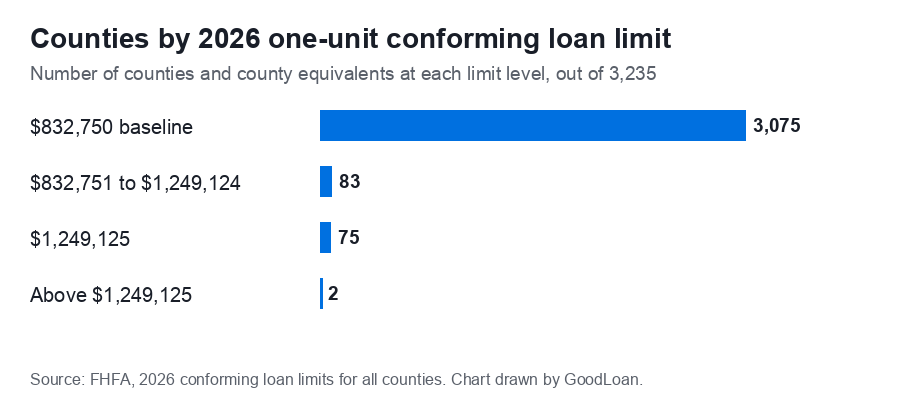
Figure 6: 95% of counties use the national baseline, so the higher limits matter in a small number of expensive places. The $1,249,125 group mixes the high-cost ceiling with the baseline in Alaska, Hawaii, Guam and the U.S. Virgin Islands. Source: Federal Housing Finance Agency, Conforming Loan Limits for 2026, all counties, Nov 2025. Chart drawn by GoodLoan from the source's data, 20 Nov 2026.
What is the conforming loan limit for 2026?
The baseline went up by about 3%, following house prices.
- The 2026 baseline rose $26,250 from 2025 because house prices rose 3.26% on average (FHFA, Nov 2025).
- The ceiling in high-cost areas is $1,249,125, which is 150% of the baseline (FHFA, Nov 2025).
- In Alaska, Hawaii, Guam and the U.S. Virgin Islands the one-unit ceiling is $1,873,675 (FHFA, Nov 2025).
- Limits went up in all but 32 counties or county equivalents (FHFA, Nov 2025).
- In baseline counties the limit is $1,066,250 for a two-unit home and $1,601,750 for a four-unit home (FHFA loan limit list, Nov 2025).
How many counties are above the baseline?
160 of them.
- 3,075 of 3,235 counties and county equivalents use the $832,750 baseline, or 95.1% (FHFA loan limit list, Nov 2025).
- 83 counties have a limit between the baseline and the high-cost ceiling (FHFA loan limit list, Nov 2025).
How many loans go over the limit?
About one conventional first mortgage in 22.
- Lenders made 146,000 jumbo first mortgages in 2025, up from 124,000 in 2024 (FHFA National Mortgage Database, Sep 2026).
- Jumbo borrowers' debt-to-income ratio averaged 40.8% in 2025, up from 38.7% in 2024 (FHFA National Mortgage Database, Sep 2026).
How large is a typical conventional loan?
Between about $340,000 and $390,000 on new loans.
- The loans Fannie Mae bought in the third quarter of 2026 averaged $339,254, against $212,420 across its whole book (Fannie Mae 10-Q, Oct 2026).
- Freddie Mac's new loans averaged $345,000, against $229,000 across its single-family portfolio (Freddie Mac 10-Q, Oct 2026).
- Conventional first mortgages made in 2025 averaged $389,000 (FHFA National Mortgage Database, Sep 2026).
How Do Conventional Loans Perform?
Conventional loans have the fewest late payments in the mortgage market. The numbers are rising anyway, and the loans made in 2022 to 2024 are carrying most of the increase.
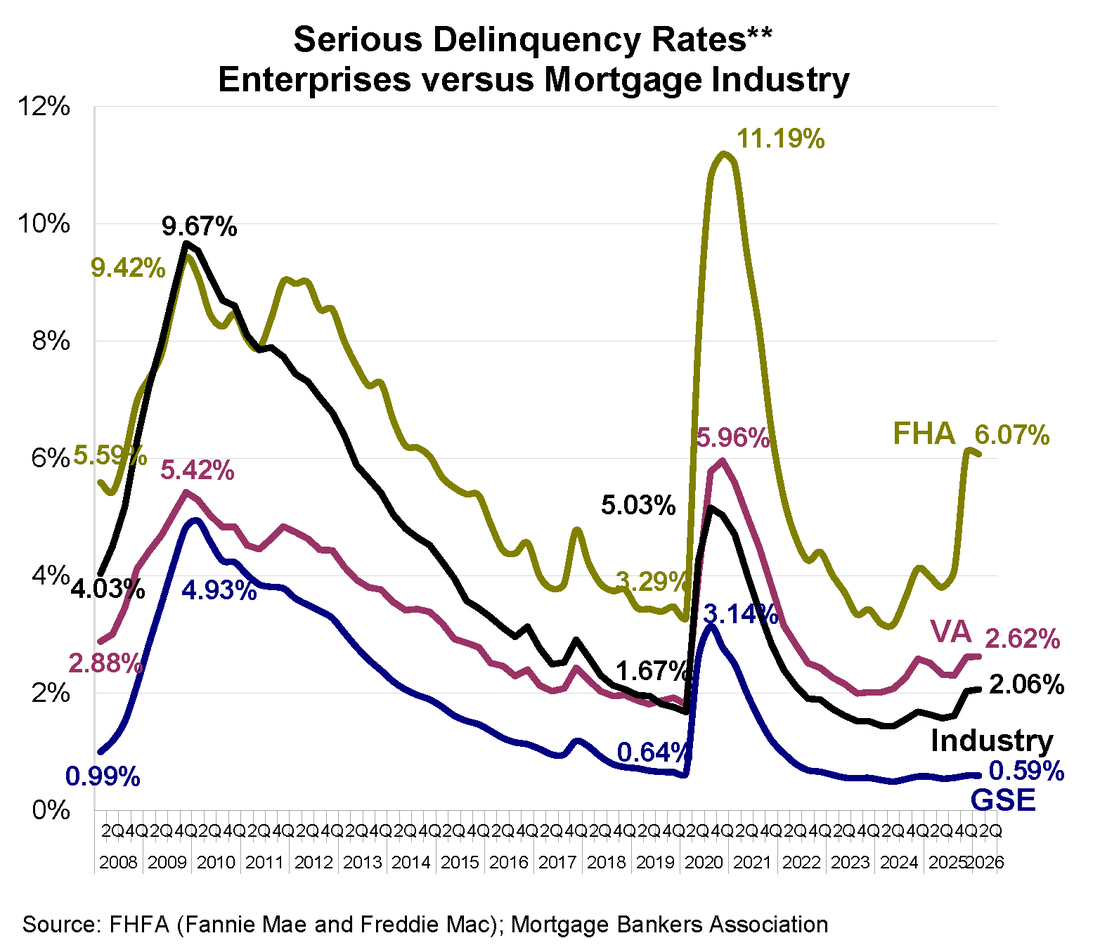
Figure 7: Fannie Mae and Freddie Mac loans have stayed the bottom line on this chart for almost two decades, and the recent rise is far smaller than the jump in FHA loans. Source: Federal Housing Finance Agency, Foreclosure Prevention and Refinance Report, Second Quarter 2026, Sep 2026; the FHA, VA and industry lines are Mortgage Bankers Association data, as the chart's footer states. Screenshot of the source page, captured 20 Nov 2026.
How often do conventional borrowers fall behind?
About one conventional loan in 37 is behind. At Fannie Mae and Freddie Mac, fewer than one loan in 150 is three months or more behind.
- The conventional delinquency rate rose 12 basis points from a year earlier, which is 0.12 of a percentage point (MBA, Aug 2026).
- The share of conventional loans seriously behind rose 6 basis points in a year, against 227 basis points for FHA loans (MBA, Aug 2026).
- 0.62% of Fannie Mae's single-family loans were 90 days or more behind or in foreclosure at the end of September 2026, up from 0.54% a year earlier (Fannie Mae 10-Q, Oct 2026).
- Freddie Mac's serious delinquency rate was 0.61%, up from 0.57% a year earlier (Freddie Mac, Oct 2026).
- Freddie Mac loans made in 2023 had a serious delinquency rate of 1.32%, against 0.56% for loans made in 2021 and earlier (Freddie Mac 10-Q, Oct 2026).
- Freddie Mac loans with primary mortgage insurance had a serious delinquency rate of 1.29%, against 0.41% for loans with no credit protection (Freddie Mac 10-Q, Oct 2026).
- At mid-2026, 0.59% of Fannie Mae and Freddie Mac loans were seriously delinquent, unchanged from the first quarter (FHFA Refinance Report, 2Q 2026, Sep 2026).
- 1.03% of Fannie Mae and Freddie Mac loans were 30 to 59 days late in August 2026 (FHFA Refinance Report, Aug 2026).
Why do conventional borrowers fall behind?
Money coming in drops, or money going out to other debts climbs.
- Too many other payments, which servicers call excessive obligations, was the reason in 17% of Fannie Mae and Freddie Mac delinquencies in August 2026 (FHFA Refinance Report, Aug 2026).
- Unemployment was the reason in 15% (FHFA Refinance Report, Aug 2026).
- Illness of the borrower or a family member was the reason in 11% (FHFA Refinance Report, Aug 2026).
How many conventional loans end in foreclosure?
A few thousand a quarter, out of about 30 million Fannie Mae and Freddie Mac loans.
- Fannie Mae took back 3,749 single-family homes in the first nine months of 2026, up from 2,149 in the same period of 2025 (Fannie Mae 10-Q, Oct 2026).
- Fannie Mae and Freddie Mac started 8,930 foreclosures in August 2026, up 18.0% from July (FHFA Refinance Report, Aug 2026).
- About 62,000 people had a new foreclosure on their credit report in the third quarter of 2026, across all loan types (New York Fed, Nov 2026).
- 0.67% of all mortgages were in the foreclosure process at mid-2026 (MBA, Aug 2026).
What help do borrowers get when they fall behind?
Loan changes and paused payments, about 16,000 actions a month.
- Fannie Mae and Freddie Mac completed 7,675 permanent loan modifications in August 2026 (FHFA Refinance Report, Aug 2026).
- 38,861 of their loans were in forbearance at the end of August 2026 (FHFA Refinance Report, Aug 2026).
- 74.4% of the modifications in the second quarter of 2026 cut the borrower's monthly payment by more than 20% (FHFA Refinance Report, 2Q 2026, Sep 2026).
- Fannie Mae had $6.3 billion of single-family loans in forbearance at the end of September 2026, down from $7.5 billion at the end of 2025 (Fannie Mae 10-Q, Oct 2026).
Who Makes Conventional Loans?
Thousands of lenders make conventional loans, but two of them make more first-lien conventional loans than the next eight together. Most of the top ten's volume comes from independent mortgage companies.
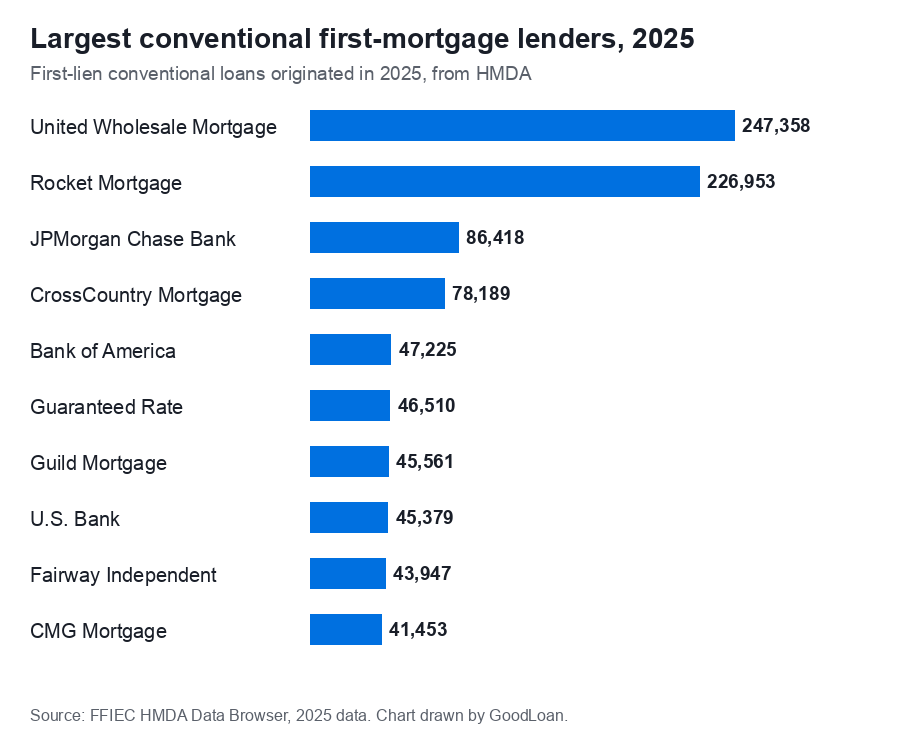
Figure 8: United Wholesale Mortgage and Rocket Mortgage each made more first-lien conventional loans than the next three lenders combined, which makes the top of this market far more concentrated than its lender count suggests. Counts are first-lien conventional loans, which include first-lien home equity lines and manufactured homes. Source: Federal Financial Institutions Examination Council, HMDA Data Browser, 2025 data, Nov 2026. Chart drawn by GoodLoan from the source's data, 20 Nov 2026.
Who are the biggest conventional lenders?
United Wholesale Mortgage and Rocket Mortgage, far ahead of the banks.
- JPMorgan Chase Bank made 86,418 first-lien conventional loans in 2025, the most of any bank (HMDA, Nov 2026).
- CrossCountry Mortgage made 78,189 (HMDA, Nov 2026).
- The ten largest lenders made 908,993 first-lien conventional loans, 24.1% of the 3,766,901 made in all (HMDA, Nov 2026).
How many lenders report mortgage data?
Thousands, from the largest national lenders to small community banks.
- About 4,768 lenders filed 2025 mortgage data under the Home Mortgage Disclosure Act (CFPB, Mar 2026).
- Lenders reported 1,728,114 denied applications for conventional loans in 2025, counting home equity lines and second mortgages (HMDA, Nov 2026).
Do banks or mortgage companies make more conventional loans?
Mortgage companies, by a wide margin at the top.
- Independent mortgage companies made 729,971 of the top ten's 908,993 first-lien conventional loans in 2025, or 80.3% (HMDA, Nov 2026).
- Bank of America reported 88,064 conventional loans of all kinds in 2025, and 47,225 of them were first liens (HMDA, Nov 2026).
- 37% of the loans Freddie Mac bought in the third quarter of 2026 came through its cash window, where it pays lenders cash, and 63% came through swaps for its securities (Freddie Mac 10-Q, Oct 2026).
Glossary
- Conventional loan: a home loan that no government agency insures or backs. FHA, VA and USDA loans are the government-backed kind.
- Conforming loan: a conventional loan small enough, and built to the rules, for Fannie Mae or Freddie Mac to buy.
- Jumbo loan: a conventional loan above the conforming loan limit.
- Conforming loan limit: the largest loan Fannie Mae and Freddie Mac can buy, set each year by the FHFA.
- Fannie Mae and Freddie Mac: two companies that buy mortgages from lenders and back them for investors. The FHFA oversees both.
- FHFA: Federal Housing Finance Agency.
- HMDA: Home Mortgage Disclosure Act, the law that makes most lenders report every application and loan each year.
- PMI: private mortgage insurance, which protects the lender when a conventional loan starts above 80% of the home's value.
- LTV: loan-to-value, the loan as a share of the home's value.
- DTI: debt-to-income, monthly debt payments as a share of monthly income.
- Cash-out refinance: a new, larger loan that replaces the old one and pays the difference to the borrower.
- Guaranty fee: the yearly fee Fannie Mae or Freddie Mac charges for backing a loan, built into the rate.
- Serious delinquency: a loan 90 days or more behind, or in foreclosure.
- Basis point: one hundredth of a percentage point.
- First lien: the main mortgage on a home, paid first if the home is sold.
Methodology and Sources
Every statistic on this page was read on the page or file of the group that produced it, in November 2026. We do not cite statistics roundups, lender blogs or news summaries. Fannie Mae numbers come from its filings on the SEC's website, which are the same documents Fannie Mae publishes. Where we worked out a share or a change ourselves, we used only the numbers in the linked source. The National Mortgage Database counts first mortgages only. HMDA counts every lien, so its all-loan conventional totals include home equity lines and second mortgages. The lender ranking uses HMDA's first-lien conventional loans, which still include first-lien home equity lines and manufactured homes. HMDA figures were read from the HMDA Data Browser in November 2026 and cover 2025 lending. Fannie Mae and Freddie Mac shares by loan-to-value, credit score, debt-to-income and loan purpose are shares of loan balances, as their filings report them. The National Mortgage Database counts a refinance as cash-out when the new loans are more than 5% above the old balances. Fannie Mae's book interest-rate shares are read from its own chart in the 10-Q. Figures from different sources measure different things and are never blended. This page is refreshed monthly as Fannie Mae, Freddie Mac, the FHFA and the Mortgage Bankers Association publish new data.
Sources
- Federal Housing Finance Agency, National Mortgage Database Aggregate Statistics
- Federal Housing Finance Agency, Foreclosure Prevention and Refinance Report, August 2026
- Federal Housing Finance Agency, Foreclosure Prevention and Refinance Report, Second Quarter 2026
- Federal Housing Finance Agency, Conforming Loan Limit Values for 2026
- Federal Housing Finance Agency, Conforming Loan Limits for 2026, all counties
- Fannie Mae, Form 10-Q for the quarter ended September 30, 2026
- Fannie Mae, Third Quarter 2026 results release
- Freddie Mac, Third Quarter 2026 Financial Results
- Freddie Mac, Form 10-Q for the quarter ended September 30, 2026
- Freddie Mac, Primary Mortgage Market Survey
- Federal Financial Institutions Examination Council, HMDA Data Browser
- Consumer Financial Protection Bureau, 2025 HMDA data on mortgage lending now available
- Consumer Financial Protection Bureau, When can I remove private mortgage insurance from my loan
- MGIC Investment Corporation, Third Quarter 2026 Results
- Essent Group, Third Quarter 2026 Financial Supplement
- Enact Holdings, Third Quarter 2026 Earnings Release
- Mortgage Bankers Association, National Delinquency Survey, second quarter 2026
- Federal Reserve Board, G.19 Consumer Credit
- Federal Reserve Bank of New York, Quarterly Report on Household Debt and Credit, 2026 Q3
- Federal Reserve Bank of New York, press release of November 10, 2026


