Updated November 2026. Refreshed monthly.
FHA lending is, above all, first-time buyer lending. In fiscal year 2026, which ended September 30, 2026, the Federal Housing Administration insured 935,283 forward mortgages, and 83.09% of its purchase loans went to people buying their first home (HUD FHA Annual Report, Nov 2026).
The program is changing shape. Refinances are climbing for a third straight year, and more buyers lean on down payment help than at any time in 16 years. The share of FHA loans far behind on payments has also jumped, partly because HUD changed how it helps borrowers in trouble.
Every number below links to the group that produced it: HUD and the FHA, Ginnie Mae, the federal mortgage data that lenders report under HMDA, the Mortgage Bankers Association, Freddie Mac and the Federal Reserve. No roundups, no copies of copies.
Key Takeaways
- FHA loans were 13.3% of all home loans made in 2025, 906,942 of 6,827,891 (FFIEC HMDA, Mar 2026).
- 44.47% of FHA home buyers used down payment assistance in fiscal year 2026, the highest share in 16 years (HUD FHA Annual Report, Nov 2026).
- FHA streamline refinances went from 1,041 in fiscal year 2023 to 107,146 in fiscal year 2026 (HUD FHA Annual Report, Nov 2026).
- 11.79% of FHA loans were behind on payments in mid-2026, against 2.72% of conventional loans (MBA, Aug 2026).
- 540,410 FHA loans were seriously delinquent in August 2026, up 49.8% in a year (HUD Production Report, Sep 2026).
- The FHA insurance fund held a capital ratio of 10.29%, more than five times the 2% the law requires (HUD FHA Annual Report, Nov 2026).
- Nonbank lenders made 91.22% of FHA loans in fiscal year 2026 (HUD FHA Annual Report, Nov 2026).
- Two lenders, United Wholesale Mortgage and Rocket Mortgage, made 16.8% of all FHA loans in 2025 (FFIEC HMDA, Mar 2026).
- The FHA upfront mortgage insurance premium is 1.75% of the base loan amount (HUD Handbook 4000.1, Aug 2026).
- The 2026 FHA loan limit for a one-unit home runs from $541,287 to $1,249,125, depending on the county (HUD Mortgagee Letter 2025-23, Dec 2025).
- 50.7% of the FHA loan balances in Ginnie Mae pools carry a rate of 5.0% or less (Ginnie Mae, Oct 2026).
- The average 30-year fixed mortgage rate is 7.28%, up from 6.26% a year ago (Freddie Mac, Nov 2026).
How Big Is the FHA Loan Program?
FHA insures about one home loan in every eight, and its book has never been bigger.
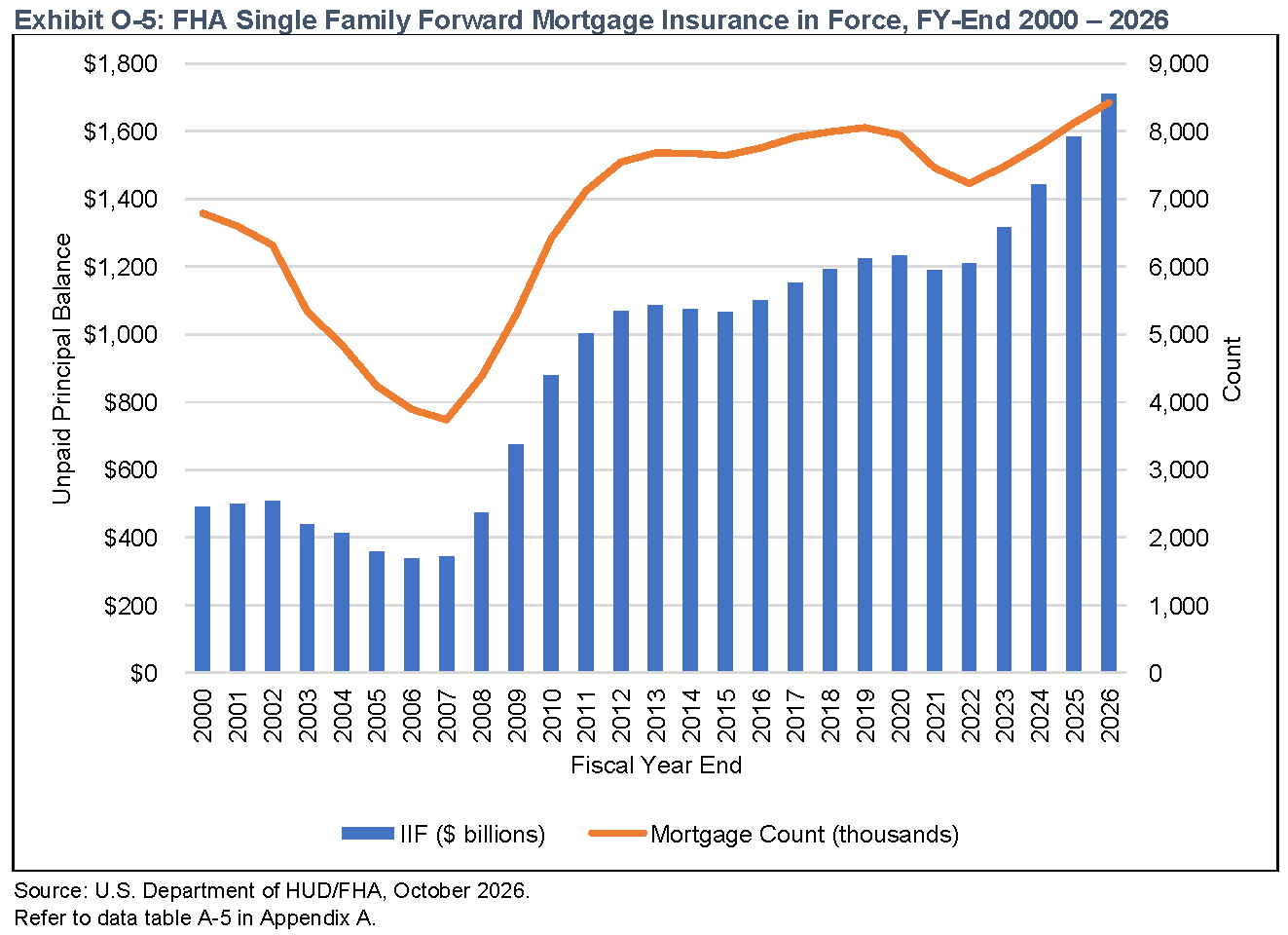
Figure 1: The dollar value of FHA-insured loans has climbed every year since 2022 and now tops $1.7 trillion, while the loan count only recently passed its 2019 high, so each loan is carrying a bigger balance. Source: U.S. Department of Housing and Urban Development, Annual Report to Congress on the Financial Status of the FHA Mutual Mortgage Insurance Fund, Fiscal Year 2026, Exhibit O-5, Nov 2026. Screenshot of the source page, captured 20 Nov 2026.
How many FHA loans are made each year?
Close to a million, and the count rose in 2026.
- FHA insured 876,490 forward mortgages in fiscal year 2025 (HUD Production Report, Sep 2026).
- In August 2026 alone, FHA insured 78,925 loans worth $24.7 billion (HUD Production Report, Sep 2026).
- Lenders sent FHA 123,536 new loan applications in March 2026, the most of any month since at least January 2024 (HUD Production Report, Sep 2026).
- FHA loans made in 2025 added up to about $288.6 billion (FFIEC HMDA, Mar 2026).
How much FHA insurance is outstanding?
About $1.7 trillion on more than 8 million homes.
- FHA insured 8.4 million forward mortgages with $1.71 trillion in unpaid balances at the end of fiscal year 2026, up 8% from $1.58 trillion a year earlier (HUD FHA Annual Report, Nov 2026).
- At the end of fiscal year 2000 the book was $491 billion, so it has grown about 3.5 times since (HUD FHA Annual Report, Nov 2026).
- FHA loans backed $1,599.5 billion of Ginnie Mae securities in September 2026, or 57.0% of all Ginnie Mae single-family securities (Ginnie Mae, Oct 2026).
What share of the mortgage market is FHA?
About 13% by dollars, more on purchases than on refinances.
- FHA's share of mortgage dollars was 13% in 2025: 15% of purchase lending and 10% of refinance lending (HUD FHA Annual Report, Nov 2026).
- Before the 2008 housing crash, from 2005 through 2007, FHA's share was only two to three percent (HUD FHA Annual Report, Nov 2026).
- FHA added $90.0 billion of net new Ginnie Mae securities in 2026 through September, against $57.6 billion for VA loans (Ginnie Mae, Oct 2026).
Who Uses FHA Loans?
The FHA borrower is a first-time buyer with a small down payment and a credit score in the 600s. That profile has held for years, and it is the reason the program exists.
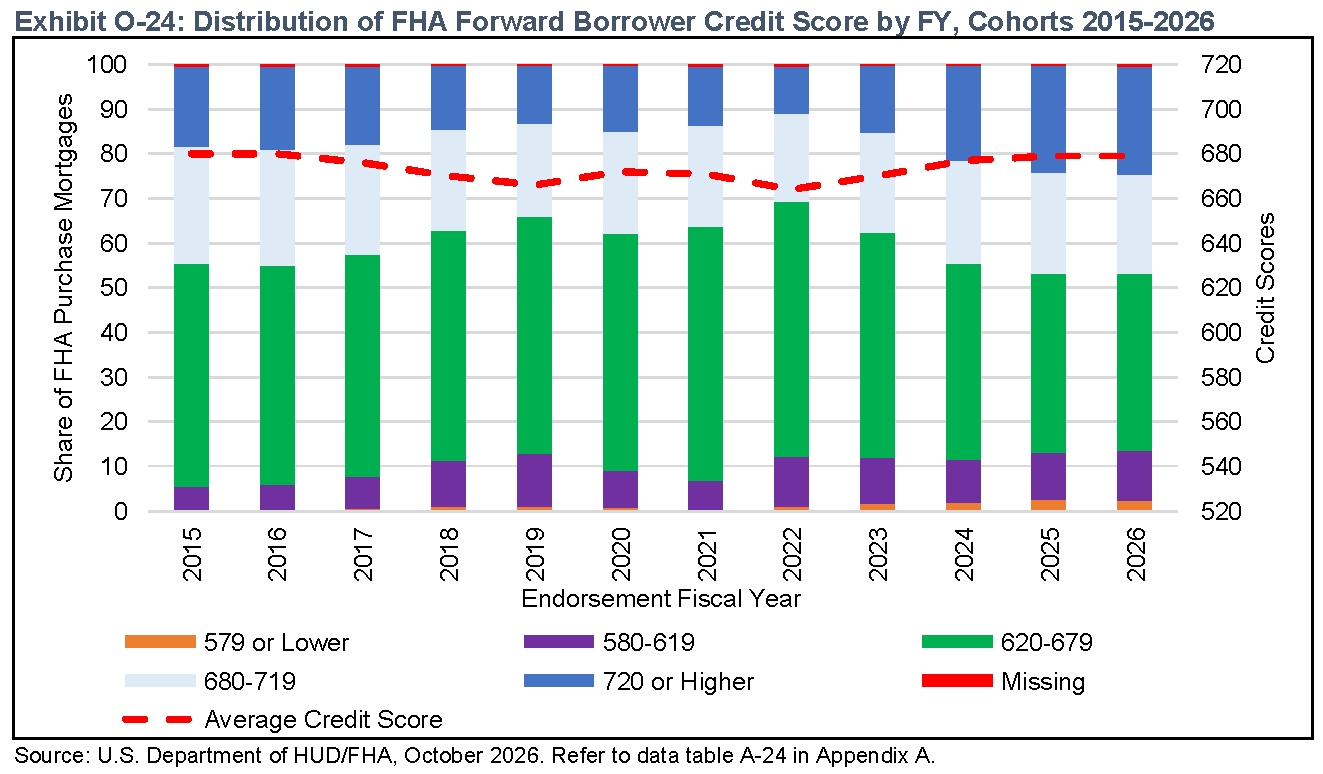
Figure 2: The share of FHA borrowers scoring 720 or higher has more than doubled since 2022, yet the 620 to 679 band is still the biggest, so the program serves both ends of the score range. Source: U.S. Department of Housing and Urban Development, FHA Mutual Mortgage Insurance Fund Annual Report Fiscal Year 2026, Exhibit O-24, Nov 2026. Screenshot of the source page, captured 20 Nov 2026.
Are most FHA borrowers first-time buyers?
Yes. More than four in five FHA purchase loans go to first-time buyers.
- First-time buyers took 81.56% of FHA purchase loans in fiscal year 2000, close to the share today (HUD FHA Annual Report, Nov 2026).
- In the Ginnie Mae purchase market, 81.4% of FHA loans financed a first-time buyer in September 2026, against 54.5% of VA loans (Ginnie Mae, Oct 2026).
- Home purchases were 640,557 of the FHA loans made in 2025, or 70.6% (FFIEC HMDA, Mar 2026).
- The average FHA first-time buyer in September 2026 borrowed $322,882 (Ginnie Mae, Oct 2026).
What credit scores do FHA borrowers have?
Mostly in the 600s, with an average a little under 680. VA and FHA program rules allow credit scores as low as 500.
- FHA home buyers had an average credit score of 685 in fiscal year 2026, and FHA borrowers overall, streamline refinances aside, averaged 679 (HUD FHA Annual Report, Nov 2026).
- 24.33% of FHA borrowers in fiscal year 2026, streamline refinances aside, scored 720 or higher, up from 10.63% in fiscal year 2022 (HUD FHA Annual Report, Nov 2026).
- 11.20% of those borrowers scored 580 to 619, and 2.34% scored 579 or lower (HUD FHA Annual Report, Nov 2026).
- FHA rules allow full financing at a score of 580 or higher, and cap the loan at 90% of the home's value for scores from 500 to 579 (HUD Handbook 4000.1, Aug 2026).
- The average first-time FHA buyer in September 2026 had a credit score of 690 and a debt-to-income ratio of 44.5% (Ginnie Mae, Oct 2026).
How much do FHA buyers put down?
Usually about 5% or less, and often with help.
- The largest FHA purchase loan allowed is 96.5% of the home's adjusted value, which leaves a 3.5% minimum down payment (HUD Handbook 4000.1, Aug 2026).
- The average FHA purchase loan was 94.99% of the home's value in fiscal year 2026 (HUD FHA Annual Report, Nov 2026).
- Gifts from family were the most common source of down payment help, used on 23.12% of FHA purchase loans, and government programs helped on 19.99% (HUD FHA Annual Report, Nov 2026).
- FHA buyers spent an average 44.42% of their income on debt payments in fiscal year 2026, and 29.52% of them spent more than half (HUD FHA Annual Report, Nov 2026).
What kinds of homes do FHA buyers finance?
Mostly detached single-family houses.
- 85.8% of FHA loans in fiscal year 2026 through August were on detached single-family homes (HUD Production Report, Sep 2026).
- Manufactured homes on their own land were 4.5%, condominiums 1.9% and two to four unit properties 1.8% (HUD Production Report, Sep 2026).
How Common Is FHA Refinancing?
Refinancing is the part of FHA that changes most from year to year. Rate-drop refinances are surging back, while cash-out refinances have held steady in number even as their share of refinances shrank.
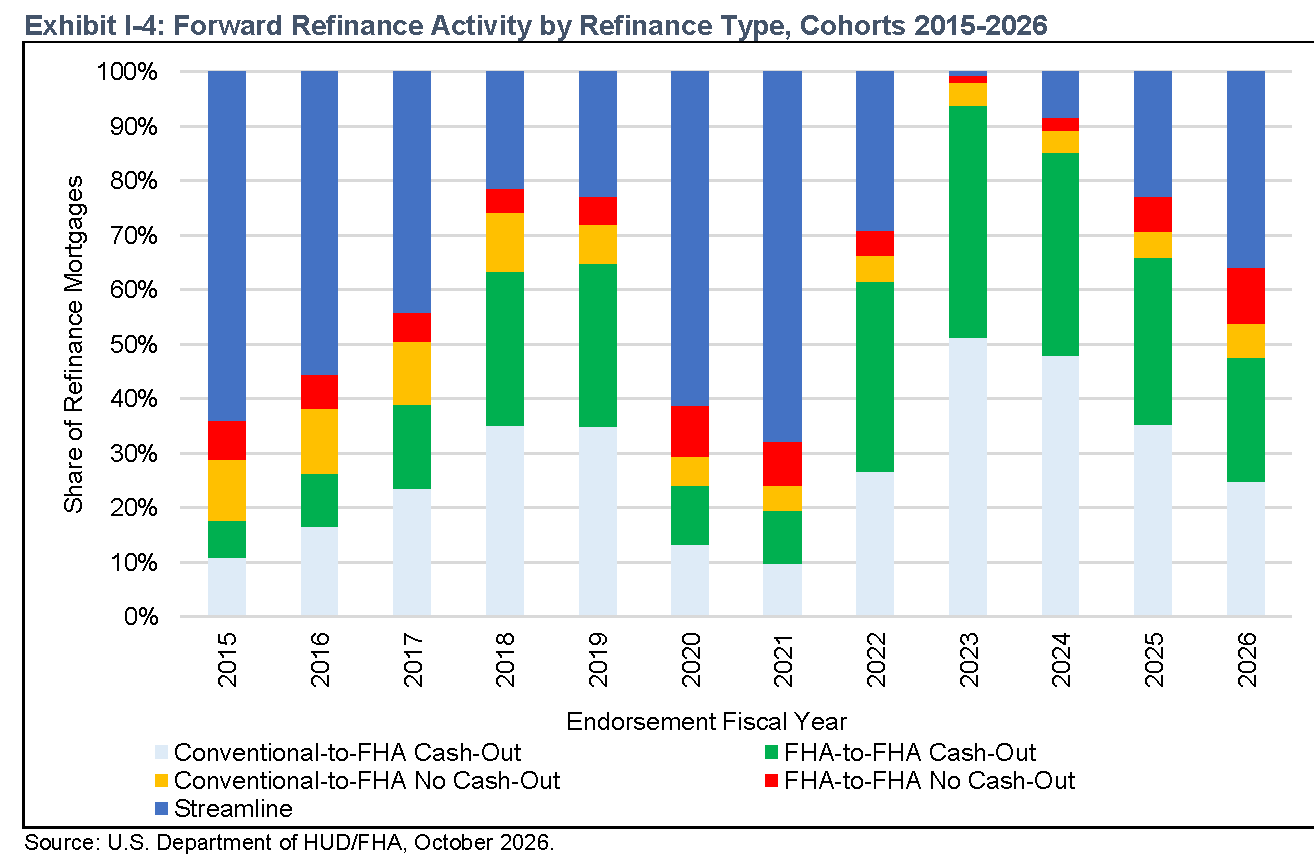
Figure 3: Cash-out refinances, the green and pale blue bars, took over FHA refinancing in 2023 and 2024 and gave ground to streamlines in 2026, which shows how much the mix depends on where rates sit. Source: U.S. Department of Housing and Urban Development, FHA Mutual Mortgage Insurance Fund Annual Report Fiscal Year 2026, Exhibit I-4, Nov 2026. Screenshot of the source page, captured 20 Nov 2026.
How many FHA borrowers refinance?
Almost a third of FHA loans in 2026 were refinances.
- FHA insured 297,164 refinances in fiscal year 2026, or 31.77% of all its forward loans, the third year in a row that share rose (HUD FHA Annual Report, Nov 2026).
- Refinances out of a conventional loan into FHA were 30.98% of FHA refinances in fiscal year 2026, down from 55.34% in fiscal year 2023 (HUD FHA Annual Report, Nov 2026).
- At the fiscal year 2021 peak, FHA insured 397,595 streamline refinances (HUD FHA Annual Report, Nov 2026).
- Streamline refinance applications fell from 17,835 in March 2026 to 3,874 in August 2026 (HUD Production Report, Sep 2026).
How big is FHA cash-out refinancing?
Around 140,000 loans a year, and the most common kind of FHA refinance in most recent years.
- FHA insured 141,154 cash-out refinances in fiscal year 2026, 47.50% of its refinances, down from 65.77% in fiscal year 2025 (HUD FHA Annual Report, Nov 2026).
- In August 2026, 74.0% of fully underwritten FHA-to-FHA refinances and 82.2% of conventional-to-FHA refinances took cash out (HUD Production Report, Sep 2026).
- Lenders reported 137,966 FHA cash-out refinances made in 2025, 15.2% of all FHA loans that year (FFIEC HMDA, Mar 2026).
- Lenders reported another 114,566 FHA refinances without cash out in 2025 (FFIEC HMDA, Mar 2026).
- Cash-out refinances were 11.2% of new FHA loans pooled by Ginnie Mae in September 2026, and refinances without cash out were 7.9% (Ginnie Mae, Oct 2026).
What are the rules for an FHA cash-out refinance?
The new loan can be up to 80% of the home's value, and the borrower needs a steady payment record.
- An FHA cash-out refinance can be at most 80% of the home's adjusted value, counting any second loan (HUD Handbook 4000.1, Aug 2026).
- The home must have at least six months of payments on the current loan, and every mortgage payment in the past 12 months must have been made within the month due (HUD Handbook 4000.1, Aug 2026).
- The average conventional-to-FHA cash-out loan was 68.26% of the home's value in fiscal year 2026, and the average FHA-to-FHA cash-out loan was 72.51% (HUD FHA Annual Report, Nov 2026).
What does the debt next to the mortgage cost?
Card interest runs close to three times the average mortgage rate.
- The average credit card rate was 21.19% in the third quarter of 2026 (Federal Reserve, Sep 2026).
- Americans owed $1.29 trillion on credit cards (New York Fed, Nov 2026).
- Total household debt reached $19.11 trillion, up $334 billion in the third quarter of 2026 (New York Fed, Nov 2026).
If you want to see what an FHA cash-out plan could look like with every debt in one place, and what you could keep each month, we build that at goodloan.ai. Call, text or chat (866) 599-0088, 8am to 8pm Eastern.
What Does FHA Mortgage Insurance Cost?
Mortgage insurance is the price of FHA's low down payment. It comes in two parts, a one-time premium and a yearly one, and the yearly part was cut in 2023 and has not changed since.
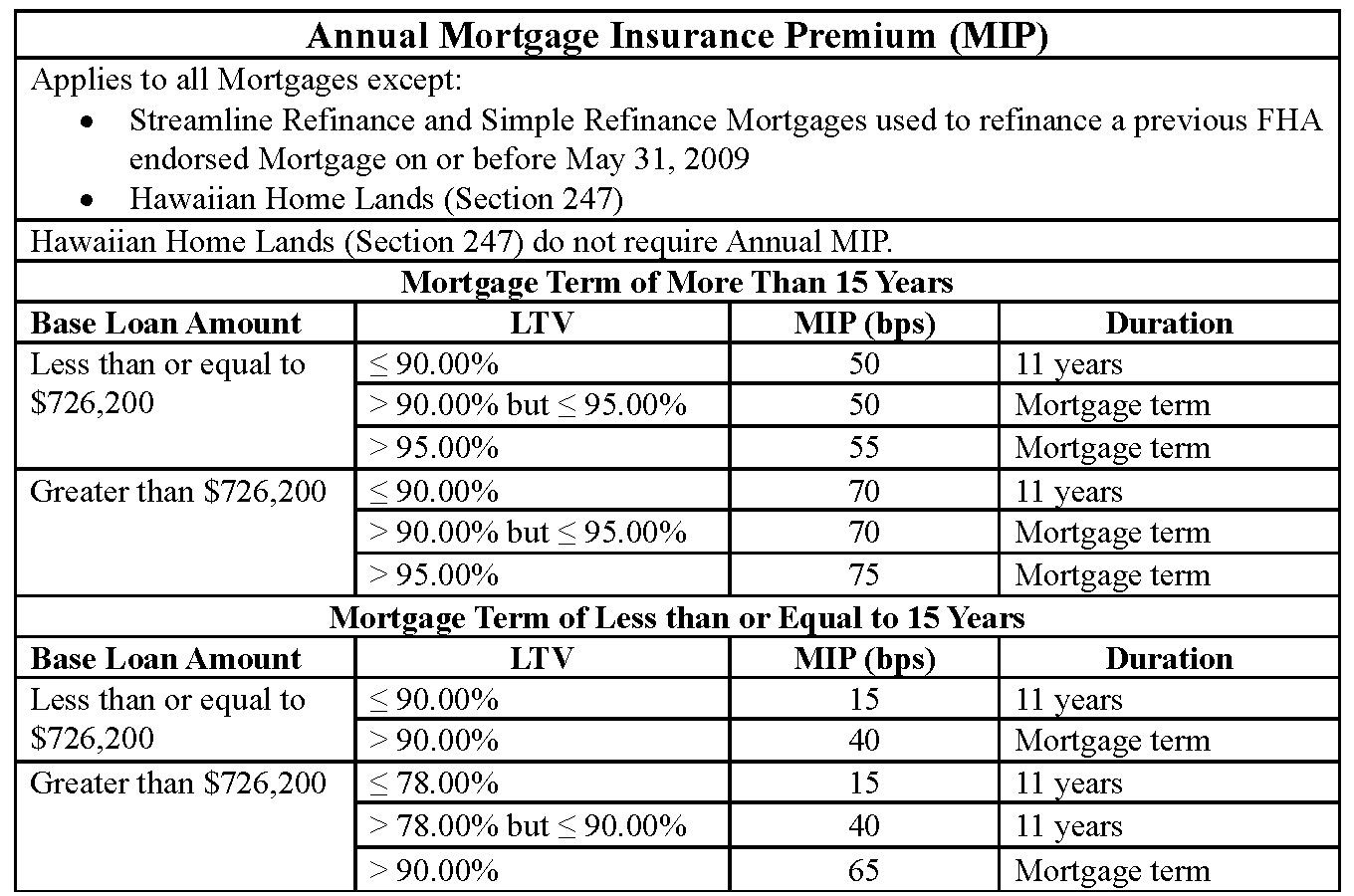
Figure 4: On a typical 30-year FHA loan the yearly premium is 0.50% or 0.55% of the loan, and it ends after 11 years only when the loan starts at 90% of the home's value or less. Source: U.S. Department of Housing and Urban Development, FHA Single Family Housing Policy Handbook 4000.1, Appendix 1.0, Aug 2026. Screenshot of the source page, captured 20 Nov 2026.
How much is the annual FHA premium, and how long does it last?
Between 0.15% and 0.75% of the loan a year, depending on the loan size, term and down payment.
- On a loan over 15 years and up to $726,200, the yearly premium is 0.50% when the loan is 95% of the home's value or less, and 0.55% above that (HUD Handbook 4000.1, Aug 2026).
- The yearly premium stops after 11 years when the loan starts at 90% of the home's value or less, and lasts for the life of the loan above that (HUD Handbook 4000.1, Aug 2026).
- Loans over $726,200 pay 0.70% to 0.75% a year on terms over 15 years (HUD Handbook 4000.1, Aug 2026).
- On loans of 15 years or less, the yearly premium can be as little as 0.15% (HUD Handbook 4000.1, Aug 2026).
How much did the 2023 premium cut change?
It cut the yearly premium on new loans by about a third.
- Loans insured since the 2023 cut pay about 35% less in yearly premiums on average, 53 basis points against 83 on older loans (HUD FHA Annual Report, Nov 2026).
- Loans with the lower premium now make up nearly half of FHA's book (HUD FHA Annual Report, Nov 2026).
- For a streamline refinance, the new combined rate, meaning the interest rate plus the premium rate, must be at least 0.5 points below the old one when going fixed to fixed (HUD Handbook 4000.1, Aug 2026).
What rates do FHA loans carry?
Most open FHA loans carry rates well under today's average for a new mortgage.
- 35.5% of FHA loan balances in Ginnie Mae pools carry a rate between 5.5% and 6.5% (Ginnie Mae, Oct 2026).
- The average 15-year fixed mortgage rate is 6.66%, up from 5.54% a year ago (Freddie Mac, Nov 2026).
If you want to see the mortgage insurance laid out next to every other bill in one plan, we build that at goodloan.ai. Call, text or chat (866) 599-0088, 8am to 8pm Eastern.
How Much Can You Borrow With an FHA Loan?
FHA limits move with home prices every January, and in most counties the cap is well above what a typical FHA buyer borrows.
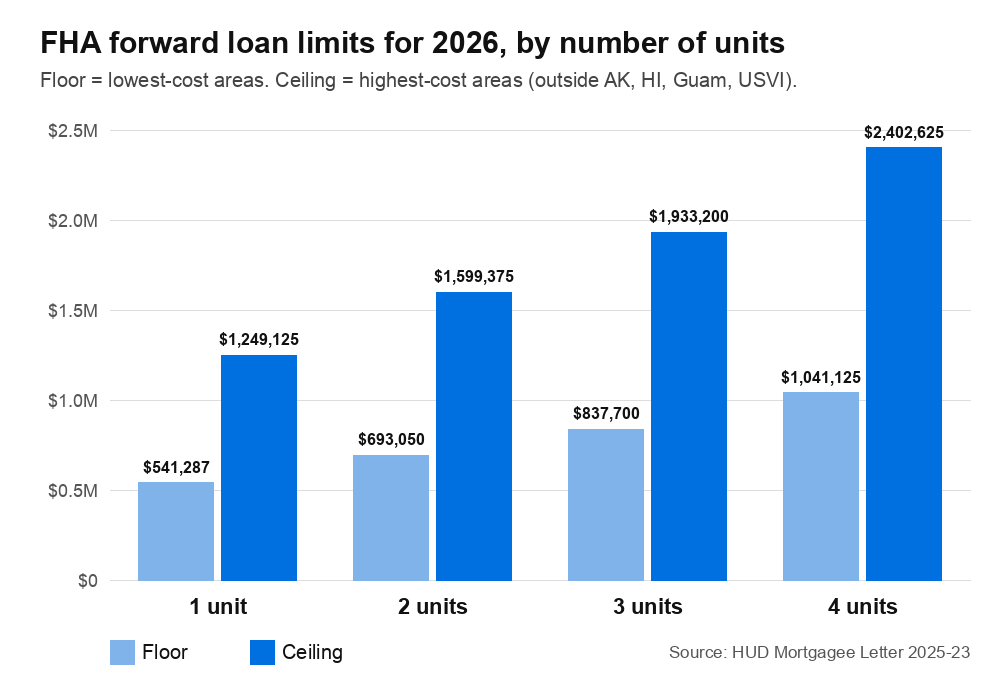
Figure 5: Even the floor for a one-unit home sits far above the average FHA loan, so the limit matters mainly in expensive counties. Source: U.S. Department of Housing and Urban Development, Mortgagee Letter 2025-23, 2026 Nationwide Forward Mortgage Limits, Dec 2025. Chart drawn by GoodLoan from the source's data, 20 Nov 2026.
How are FHA loan limits set?
As fixed shares of the national conforming loan limit, adjusted for local home prices.
- The FHA floor is set at 65% of the national conforming loan limit, and the ceiling at 150% (HUD Mortgagee Letter 2025-23, Dec 2025).
- The national conforming loan limit for a one-unit home is $832,750 in 2026 (FHFA, Nov 2025).
- Inside the range, each area's limit is based on the county with the highest median home price in the metro area (HUD Mortgagee Letter 2025-23, Dec 2025).
What are the limits for two to four unit homes?
Higher, rising with each unit.
- The 2026 floor is $693,050 for two units, $837,700 for three and $1,041,125 for four (HUD Mortgagee Letter 2025-23, Dec 2025).
- The 2026 ceiling is $1,599,375 for two units, $1,933,200 for three and $2,402,625 for four (HUD Mortgagee Letter 2025-23, Dec 2025).
- In Alaska, Hawaii, Guam and the U.S. Virgin Islands the one-unit ceiling is $1,873,625 (HUD Mortgagee Letter 2025-23, Dec 2025).
How big is the typical FHA loan?
Far below the loan limit in most of the country, and much larger in high-price states.
- The average FHA loan made in 2025 was about $318,000 (FFIEC HMDA, Mar 2026).
- In California the average FHA loan made in 2025 was about $504,000, and in Texas about $302,000 (FFIEC HMDA, Mar 2026).
How Do FHA Loans Perform?
FHA loans fall behind more often than any other major loan type. That is the trade-off of lending to buyers with thin savings and small down payments, and in 2026 HUD's own rule changes pushed the count of loans far behind even higher.
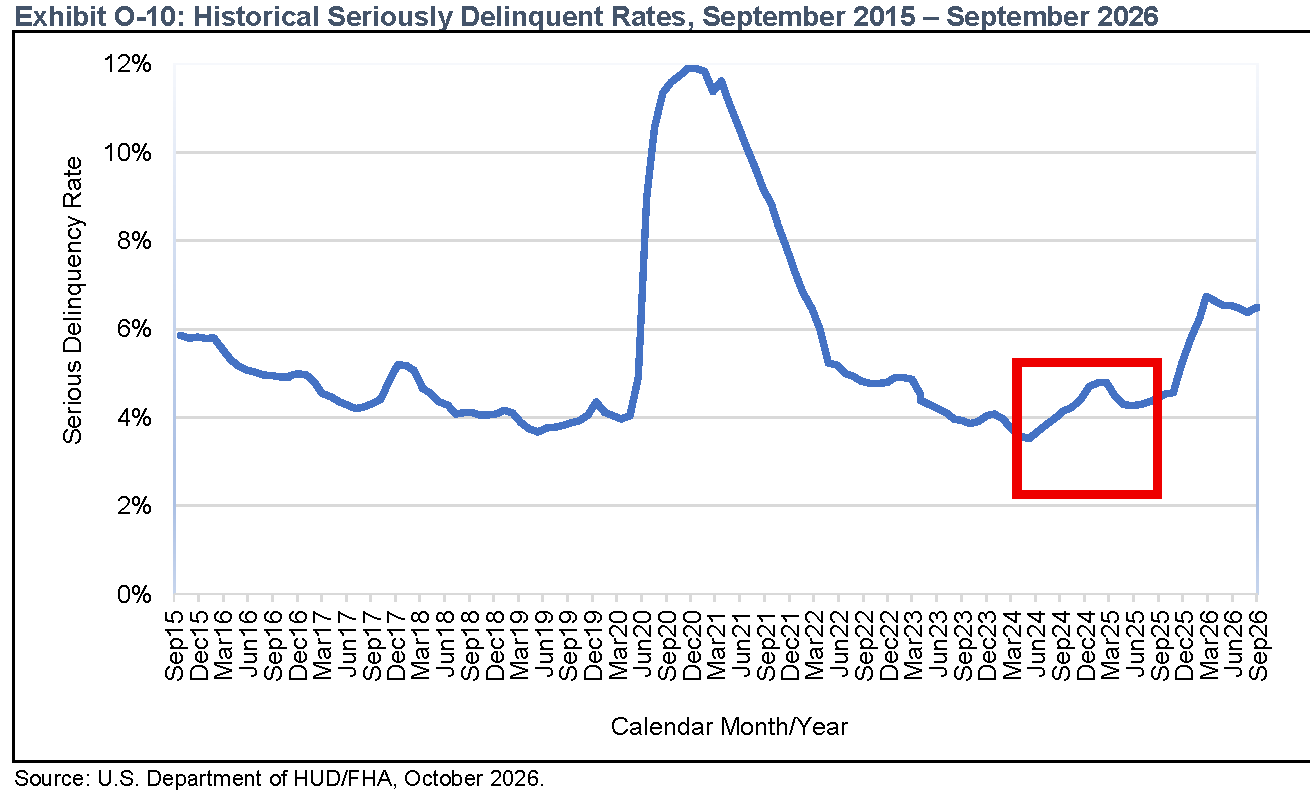
Figure 6: The FHA serious delinquency rate spiked during the pandemic, sank back to about 4%, and climbed again in 2026, which HUD ties to new rules that stopped borrowers from cycling in and out of late status. The red box marks one of those earlier cycles. Source: U.S. Department of Housing and Urban Development, FHA Mutual Mortgage Insurance Fund Annual Report Fiscal Year 2026, Exhibit O-10, Nov 2026. Screenshot of the source page, captured 20 Nov 2026.
How often do FHA borrowers fall behind?
More than one FHA loan in nine was at least 30 days late in mid-2026, and about one in fifteen was 90 days or more late.
- VA loans had a delinquency rate of 4.89% in the second quarter of 2026, and all mortgages on one to four unit homes 4.37%, up 44 basis points from a year earlier (MBA, Aug 2026).
- The FHA serious delinquency rate rose 227 basis points from a year earlier (MBA, Aug 2026).
- HUD counted 6.51% of FHA loans as 90 days or more behind in September 2026, against 4.53% in September 2025 (HUD FHA Annual Report, Nov 2026).
- FHA loans in Ginnie Mae pools had a serious delinquency rate of 6.09% in the second quarter of 2026, down 5 basis points from the first quarter (Ginnie Mae, Oct 2026).
- Loans in foreclosure were 0.67% of all mortgages, and 2.06% of all mortgages were seriously delinquent (MBA, Aug 2026).
Why did FHA serious delinquency rise in 2026?
HUD says its new rules revealed borrowers who kept falling behind after getting help.
- 2.2 million active FHA borrowers have been 90 days or more behind at some point (HUD FHA Annual Report, Nov 2026).
- About 75,000 borrowers received three or more separate help plans from fiscal year 2024 through 2026, costing FHA at least $112.5 million by HUD's estimate on loans that kept defaulting (HUD FHA Annual Report, Nov 2026).
- Since October 1, 2025, a borrower can receive a home retention option only once every 24 months (HUD FHA Annual Report, Nov 2026).
How many FHA loans end in a claim?
A small share each month.
- FHA paid 2,288 insurance claims in August 2026 (HUD Production Report, Sep 2026).
- 57,893 seriously delinquent FHA loans returned to under 90 days late in August 2026, against 65,811 that newly fell 90 days behind (HUD Production Report, Sep 2026).
- Illinois had the highest serious delinquency rate for FHA loans among the ten largest states in Ginnie Mae pools in August 2026 (Ginnie Mae, Oct 2026).
How Healthy Is the FHA Insurance Fund?
The fund that pays FHA's claims is in strong shape by its own legal yardstick, even after a year of rising late payments. It sat below zero in 2013.
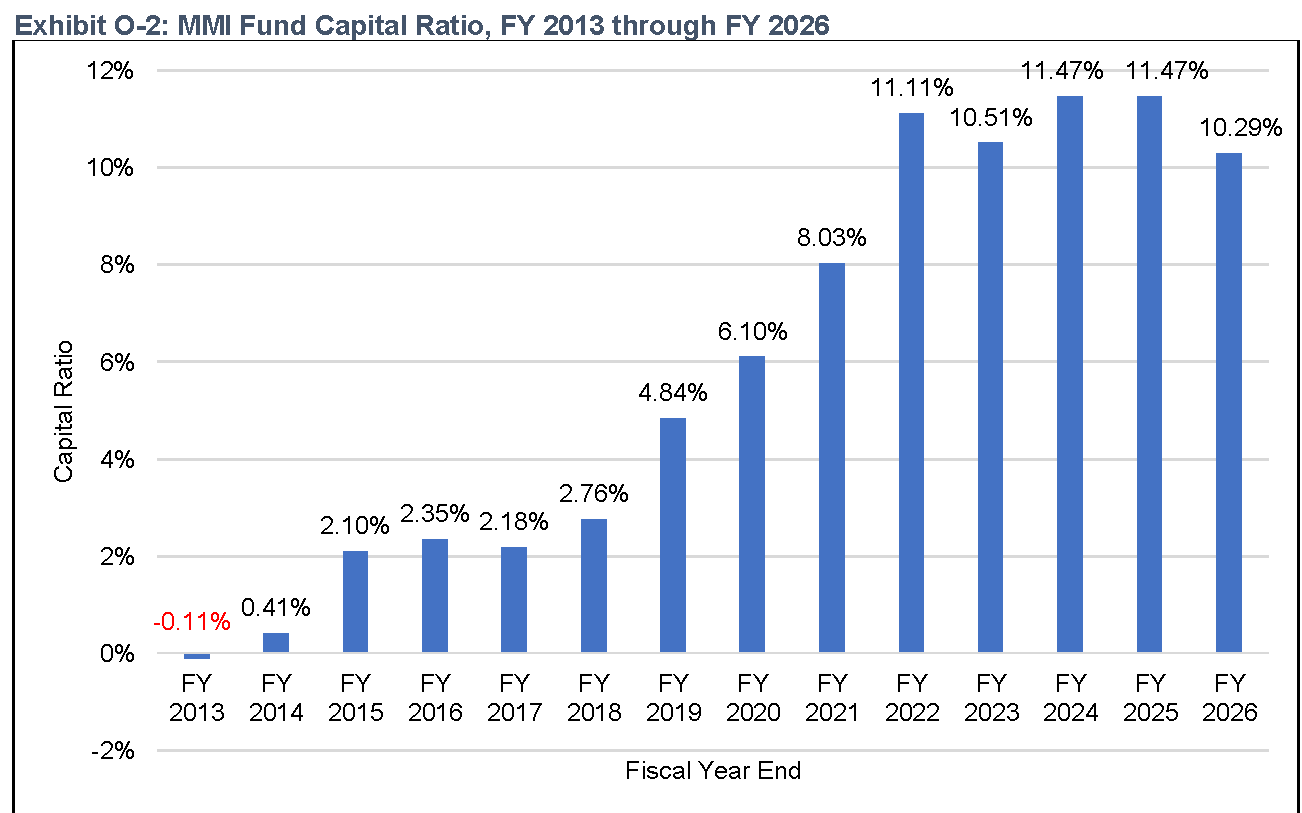
Figure 7: The capital ratio climbed from below zero in 2013 to its 2024 and 2025 peak, then eased in 2026, still far above the floor set in law. Source: U.S. Department of Housing and Urban Development, FHA Mutual Mortgage Insurance Fund Annual Report Fiscal Year 2026, Exhibit O-2, Nov 2026. Screenshot of the source page, captured 20 Nov 2026.
What is the FHA fund's capital ratio?
Well above the legal floor, though lower than a year earlier.
- The fund's capital ratio was 11.47% at the end of fiscal year 2025 (HUD FHA Annual Report, Nov 2026).
- The ratio was negative 0.11% in fiscal year 2013 (HUD FHA Annual Report, Nov 2026).
- The fund's economic net worth was $182.6 billion, down $6.3 billion in a year, while its total capital resources rose $9.3 billion to $148.9 billion (HUD FHA Annual Report, Nov 2026).
How do the home loan and reverse mortgage books compare?
The home loan book is steady. The reverse mortgage book fell hard.
- The forward mortgage book had a stand-alone capital ratio of 10.47% in fiscal year 2026, against 10.95% in 2025 (HUD FHA Annual Report, Nov 2026).
- The reverse mortgage book's ratio fell to 5.43% from 24.06% (HUD FHA Annual Report, Nov 2026).
- FHA insured 24,162 reverse mortgages in fiscal year 2026, 14.16% fewer than in 2025 (HUD FHA Annual Report, Nov 2026).
- The reverse mortgage limit rose to $1,249,125 for 2026, from $1,209,750 in 2025 (HUD, Dec 2025).
- FHA insured 264,727 reverse mortgages at the end of August 2026 (HUD Production Report, Sep 2026).
What does HUD expect the home loan book to earn and lose?
HUD projects about twice as much revenue as losses.
- HUD projects $66.2 billion in revenue from the forward book, in today's dollars, or 3.87% of the insured balance (HUD FHA Annual Report, Nov 2026).
- HUD projects $33.9 billion in losses on the same book, up $12.0 billion, or 1.98% of the insured balance against 1.39% a year earlier (HUD FHA Annual Report, Nov 2026).
Who Makes FHA Loans?
Banks have nearly left FHA lending. Independent mortgage companies now make nine FHA loans in ten, and a few of them make a big share.
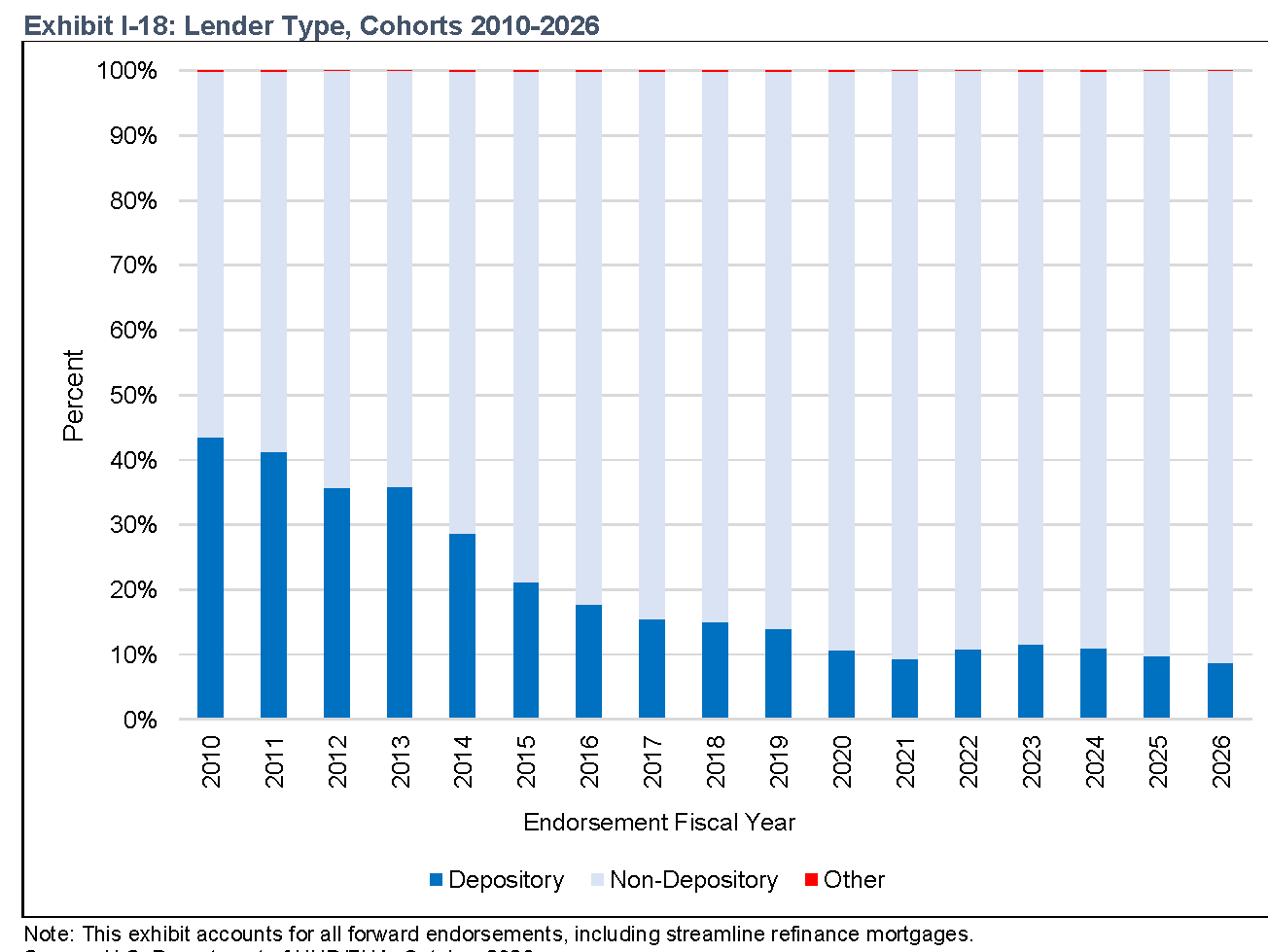
Figure 8: Banks and credit unions made more than 40% of FHA loans in 2010 and under 10% in 2026, so FHA lending is now nearly all independent mortgage companies. Source: U.S. Department of Housing and Urban Development, FHA Mutual Mortgage Insurance Fund Annual Report Fiscal Year 2026, Exhibit I-18, Nov 2026. Screenshot of the source page, captured 20 Nov 2026.
Are FHA loans made by banks or nonbanks?
Nonbanks, overwhelmingly.
- Banks and other depositories made 8.71% of FHA loans in fiscal year 2026, against 43.48% in fiscal year 2010 (HUD FHA Annual Report, Nov 2026).
- 1,277 lenders reported making at least one FHA loan in 2025 (FFIEC HMDA, Mar 2026).
Who are the biggest FHA lenders?
United Wholesale Mortgage and Rocket Mortgage, with nobody else close.
- United Wholesale Mortgage made 87,294 FHA loans in 2025, 9.6% of the total (FFIEC HMDA, Mar 2026).
- Rocket Mortgage made 65,337 FHA loans, 7.2% (FFIEC HMDA, Mar 2026).
- DHI Mortgage Company made 31,767, the third most (FFIEC HMDA, Mar 2026).
- Freedom Mortgage made 27,636 and CrossCountry Mortgage 27,608 (FFIEC HMDA, Mar 2026).
- PennyMac Loan Services made 24,044, loanDepot 22,700 and Guild Mortgage 20,919 (FFIEC HMDA, Mar 2026).
- Lennar Mortgage made 19,597 and New American Funding 18,653, rounding out the top ten (FFIEC HMDA, Mar 2026).
- The ten biggest FHA lenders made 38.1% of all FHA loans in 2025 (FFIEC HMDA, Mar 2026).
Which states have the most FHA loans?
Texas and Florida, by a wide margin.
- Texas had 106,574 FHA loans made in 2025, 20.2% of all home loans made in the state (FFIEC HMDA, Mar 2026).
- Florida had 87,249 FHA loans, 17.8% of its home loans (FFIEC HMDA, Mar 2026).
- California had 61,425 FHA loans, only 10.7% of its home loans (FFIEC HMDA, Mar 2026).
- Georgia had 45,102 FHA loans, 18.6% of its home loans (FFIEC HMDA, Mar 2026).
Glossary
- FHA loan: a home loan from a private lender that the Federal Housing Administration, part of HUD, insures against loss.
- Endorsement: the moment FHA formally insures a loan. HUD counts loans by endorsement.
- Insurance in force: all FHA-insured loans still open, measured by unpaid balance.
- MMI Fund: the Mutual Mortgage Insurance Fund, which collects FHA premiums and pays FHA claims.
- Capital ratio: the fund's economic net worth divided by the loans it insures. The law requires at least 2%.
- UFMIP: upfront mortgage insurance premium, a one-time FHA charge, usually added to the loan.
- MIP: the yearly FHA mortgage insurance premium, paid monthly.
- Basis point: one hundredth of a percentage point. 50 basis points is 0.50%.
- LTV: loan-to-value, the loan as a share of the home's value.
- DTI: debt-to-income, monthly debt payments as a share of monthly income.
- Streamline refinance: an FHA-to-FHA refinance with lighter paperwork that must lower the combined rate or term.
- Cash-out refinance: a new, larger loan that replaces the old one and pays the difference to the borrower.
- Seriously delinquent: 90 days or more behind on payments, in foreclosure or in bankruptcy.
- Reverse mortgage (HECM): a Home Equity Conversion Mortgage, an FHA loan for owners 62 and older that is repaid when they leave the home.
- HMDA: the Home Mortgage Disclosure Act, the law that makes lenders report every loan they make.
- Conforming loan limit: the largest loan Fannie Mae and Freddie Mac will buy, set each year by the FHFA.
- Fiscal year: the federal government's year, October through September. Fiscal year 2026 ended September 30, 2026.
Methodology and Sources
Every statistic on this page was read on the file or page of the group that produced it, in November 2026. We do not cite statistics roundups, lender blogs or news summaries. Lender rankings, state counts and shares from HMDA are our own counts of the 2025 loan-level data on the FFIEC HMDA platform, covering all FHA loans lenders reported as made; HMDA counts loans when they close, while HUD counts them when FHA insures them, so the two totals differ. HMDA shares compare FHA loans with every loan reported as made, including home equity lines, second liens and multifamily loans, and public HMDA loan amounts are rounded to $10,000 bands, so HMDA averages are approximate. The MBA and HUD measure late payments differently: MBA's rate counts loans 30 days or more late, and HUD's counts loans 90 days or more late. HUD's August 2026 production report runs through August, so its fiscal year figures stop one month short. This page is refreshed monthly as HUD, Ginnie Mae and the Mortgage Bankers Association publish new data.
Sources
- U.S. Department of Housing and Urban Development, Annual Report to Congress on the Financial Status of the FHA Mutual Mortgage Insurance Fund, Fiscal Year 2026
- U.S. Department of Housing and Urban Development, FHA Single Family Production Report, August 2026
- U.S. Department of Housing and Urban Development, FHA Single Family Housing Policy Handbook 4000.1, revised August 12, 2026
- U.S. Department of Housing and Urban Development, Mortgagee Letter 2025-23, 2026 Nationwide Forward Mortgage Limits
- U.S. Department of Housing and Urban Development, HUD No. 25-145, 2026 Loan Limits
- FFIEC HMDA Data Browser, 2025 FHA loans originated, nationwide
- FFIEC HMDA Data Browser, 2025 loans originated by loan type, Texas, Florida, California and Georgia
- Ginnie Mae, Global Markets Analysis Report, October 2026
- Mortgage Bankers Association, National Delinquency Survey, second quarter 2026
- Freddie Mac, Primary Mortgage Market Survey
- Federal Reserve Board, G.19 Consumer Credit
- Federal Reserve Bank of New York, Quarterly Report on Household Debt and Credit, 2026 Q3
- Federal Reserve Bank of New York, press release of November 10, 2026
- Federal Housing Finance Agency, Conforming Loan Limit Values for 2026